

Saving Civilization Part IV: Bring Back The Matchmakers


This is the final installment of Katy’s four-part series on dating. If you missed the previous posts, start with Part I here:
Saving Civilization Starts with a Date

We are living through a demographic crisis experienced by every developed nation — shrinking birth rates, delayed marriage, and collapsing family formation. Politicians argue about tax credits. Economists propose housing subsidies. Governments experiment with cash bonuses and childcare programs.
Rebuilding the dating structure is essential. But structure alone is not enough.
Parents must set the priorities.
Three years ago, Pew conducted a survey on parental goals. Nine in ten parents say it is extremely or very important that their children become financially independent and have a job or career they enjoy. Only about two in ten say getting married or having children is very or extremely important.
Cornerstone or Capstone Marriage
Maybe you’re one of the 20% who want your kid to get married, but think there’s plenty of time. You’re going to encourage your child to marry later- go to college, establish a career, pay off loans, travel the world, and find themselves. Then, after they are emotionally mature and financially secure, marriage can be a capstone for an already full life. Of course, now you know that the capstone marriage affords little to no time to have babies.
Instead, you should encourage early marriages with worldview alignment and no prior cohabitation. Those unions not only have high success rates, but also offer the added advantage of giving couples lots of time to have more than 2.1 children if they want them. This is the cornerstone understanding of marriage. Establish the relationship early and build a life together.
Children pursue what parents praise.
How do we expect our kids to prioritize family when we fail to communicate that it matters? This does not mean devaluing education or work. It means being clear about order. If marriage and family are central to human flourishing, we must say so plainly — and early.

Tell Your Daughters the Truth
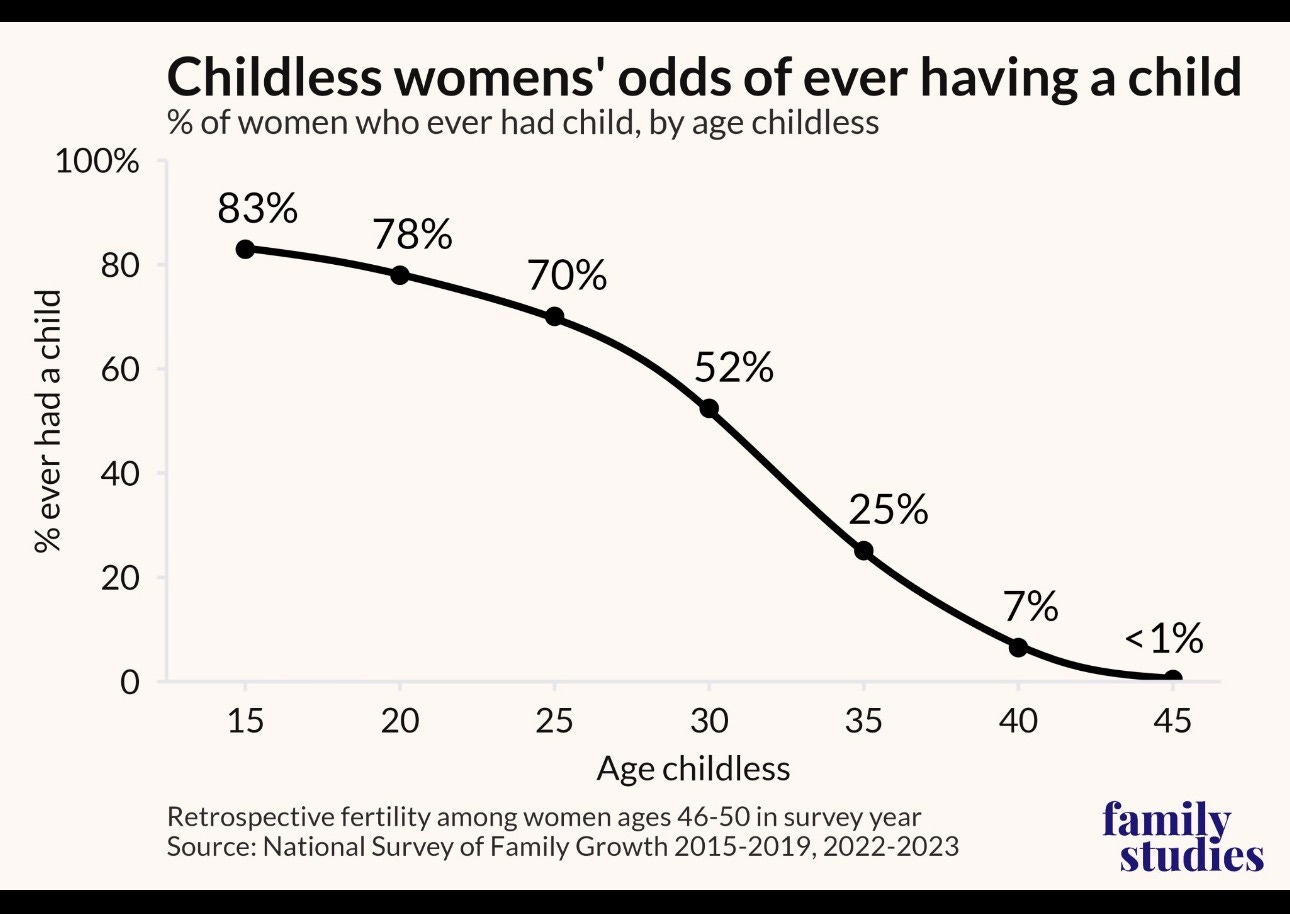
We are incredibly blessed to live in a time and country where women really can have it all. But they can not have it all at once.
If women are to have children, they must acknowledge their biological window. Unlike men, who can father children into their 70s and even 80s, women have a much shorter fertile span from late teens to early 40s, with fertility declining meaningfully after 30 and sharply after 35.
Communicating this God-ordained biology to your daughters isn’t a scare tactic.
Cultural — and often parental — messaging encourages women to prioritize education, career, and financial comfort during their prime reproductive years. Then, when the window narrows, they may be lured into the child-victimizing #BigFertility industry out of panic and desperation.
If motherhood matters to your girls, dating cannot be optional. Beyond just helping the species continue to exist, marriage and motherhood is something you should encourage in your daughters.
According to the Institute for Family Studies, married mothers are significantly more likely to report high levels of happiness compared to unmarried, childless women. Forty-seven percent of married mothers say life feels enjoyable most or all of the time, compared to 34 percent of unmarried, childless women. Marriage and motherhood also correlate with lower loneliness and greater daily affection.
Those numbers are not guarantees. But they speak to an embodied reality. Women’s natural design is oriented towards bearing and raising children. Why is it a surprise that that is what we find the most meaningful and satisfying?
You need to tell your daughter that her career path should not mirror a man’s uninterrupted ascent. Her vocation may peak later. She may work in seasons. She will likely want to be present when babies are young. There are creative ways to build work around family life.
Because her biological constraints are real, we must encourage our daughters to mold career around marriage and motherhood — not the other way around.
If motherhood matters to them, dating must begin early enough to make it possible.
Call Your Sons Up
We speak honestly to daughters about biology. We must speak just as clearly to sons about responsibility.
Young men need a vision for themselves that is larger than comfort and entertainment. If marriage and family are the goal, then boys must be trained early to see themselves as protectors, providers, and initiators.
That does not begin at 25. It begins at 10.
Protection starts with self-control. Teach boys that strength is restraint, not dominance. They protect by honoring girls as sisters in Christ, not as conquests. They protect by managing their bodies, screens, tempers, and words. A young man who cannot govern himself cannot lead a family.
Provision begins long before a paycheck. Encourage boys to work early. Let them mow lawns, shovel snow, build fences, work construction, tutor, or babysit. Give them increasing responsibility in the home. Require them to contribute, not just consume. A boy who learns that he is capable of producing value gains confidence — and confidence fuels initiative.
Initiation must be cultivated intentionally. Start by boys holding the door open for their sisters, helping their mother carry in the groceries. They should offer, not just respond to requests.
Boys should be taught that asking a girl out is honorable. That clarity is kind. That leadership in dating does not mean control, but initiative. Fathers especially must model this. Show your sons what it looks like to pursue their mother with consistency and respect. Let them see the voluntary adoption of responsibility on behalf of others, lived out in their own home by their own father.
Young men need older men in their lives who will say plainly: your future wife and children, if God grants them, will depend in part on the habits you build now. Your discipline, your work ethic, and your spiritual maturity are not empty repetition, but preparation.
If we want confident husbands and engaged fathers, we must stop raising passive boys. Give them responsibility early. Expect them to rise to it. Call them up, and praise them when they respond.
Marriage matures men. But the men who pursue it are usually the ones who were prepared for responsibility long before the wedding.

Bring Back the Matchmakers
Christians need more than the right ideas about dating, marriage, and children. We need to actively shepherd the next generation toward them.
I work in the marriage and family world. I travel frequently. I meet wonderful singles — devout, committed to chastity, serious about faith — who desperately want marriage but cannot find a date.
So I started a small matchmaking effort.
What I discovered was telling. It is not enough to introduce two people who align on eight out of ten desired traits. Nearly all of them needed coaching and encouragement just to agree to three Level Two dates.
They do not only need introductions to worldview-aligned singles. They need embodied advice and guidance from wise adults who are several steps ahead of them.
Many of these young men and women are not failing to marry because they lack faith or desire. They are failing because no one is helping them navigate the process.
That is a job for the body of Christ.
There should be a matchmaker in every church.
Specifically, a married older woman who knows the singles personally and prioritizes moral alignment over mogging.
If that is you, and you are willing to serve the singles in your world, do it thoughtfully.
Match within reasonable bands of attractiveness. Acknowledge that women often prefer slightly older men and men often prefer slightly younger women within a modest age span. Use prayer and discernment.
And make yourself — and hopefully your husband — available to coach both the young man and the young woman through some of the shockingly basic questions that you were never asking when you were dating in the 80s, 90s, or early 2000s.
This is an area of discipleship that the church has too long neglected.
I’ve made a version of my matchmaking sequence available here. Take it and make it your own.

Don’t Outsource Courtship to Silicon Valley
Dating apps are tools. If they move two people quickly into intentional, embodied interaction, they can serve a purpose. But most train users to evaluate people the way they evaluate products — swiping for upgrades, prioritizing attractiveness over alignment, keeping one eye open for a better option.
A consumer mindset corrodes commitment before it begins.
Because human introduction will almost always outperform digital consumption, the church should not outsource matchmaking to Silicon Valley.
Churches Must Do More Than Hope and Preach
Not everyone is a parent.
Not everyone is called to be a matchmaker.
But every Christian community can do something many young people cannot do for themselves: create environments where relationships can actually begin.
Young adults today often lack the basic social architecture that previous generations took for granted. They do not naturally find themselves in rooms full of peers, interacting regularly with members of the opposite sex, learning how to converse, collaborate, and form friendships that might eventually become something more.
Churches can construct that architecture.
Simply put: young people need more opportunities for embodied, in-person interaction — especially with peers of the opposite sex who share their faith and values.
Most healthy relationships do not begin with a dramatic moment. They begin with repeated contact. Conversations after church. Shared meals. Service projects. Volleyball games. Group dinners. Choir practice. Campus ministry events. A thousand ordinary interactions that slowly build familiarity and interest.
For many young Christians today, those environments barely exist.
And that is something the church can change. We can intentionally create spaces where relationships can form.
That means:
Hosting structured social nights
Investing in singles and college ministries
Intentionally introducing families
Coed Church sports teams
Pairing older couples with younger singles for discipleship and guidance
Speaking positively about early marriage
Affirming from the pulpit that dating done rightly honors God’s design
We cannot preach about marriage while passively watching singleness stretch indefinitely into the 30s. Especially when those young adults would desperately like to find a spouse. Be the church, and help bring them together.
Toward Renewal
Every civilization ultimately rises or falls on the strength of its families.
Families form when men and women meet, discern wisely, marry faithfully, and raise the next generation. Governments can subsidize housing and offer tax credits, but they cannot manufacture the relationships that produce those families.
Those relationships grow out of culture — a culture that encourages men and women to meet, to date, to evaluate wisely, and to commit to one another for life.
If Christians want to see strong marriages, vibrant churches, and a flourishing society, we must rebuild that culture intentionally. And then we need to export that culture to the nation.
Because the future of the family begins long before the wedding day.
It begins with a date.

Saving Civilization Starts with a Date
We are living through a demographic crisis experienced by every developed nation — shrinking birth rates, delayed marriage, and collapsing family formation. Politicians argue about tax credits. Economists propose housing subsidies. Governments experiment with cash bonuses and childcare programs.
Saving Civilization Part II - Restoring the Structure from the Foundation

Dating can’t be chaos. It is structured. When structure disappears, paralysis replaces it.
Saving Civilization Part III - Dating for Evaluation, Not Intoxication

When it’s time to move to Dating Level Three, you must be clear about what it is for. Dating is for evaluation, not intoxication. Level Three dating is where couples must get serious. Not just about a wedding, but about forming a successful lifelong marriage. That means daters need to be clear-eyed about two things specifically:
 | A guest post by
|