

Orphans at the Nurses' Station
One nurse's view of the double standard with surrogacy vs. abandonment

This is a guest post from a nurse who got in touch with Them Before Us. This essay reflects patterns the author has witnessed over years of labor and delivery nursing. Identifying details of specific patients have been altered or composited to protect privacy.
I work in labor and delivery. I've seen what surrogacy does to mothers and babies with my own eyes. I've worked this unit long enough to have watched our culture change in real time. These two stories, drawn from different seasons of my career, say everything about that change. I don't think you'll need me to explain the double standard; you'll see it.
Story #1
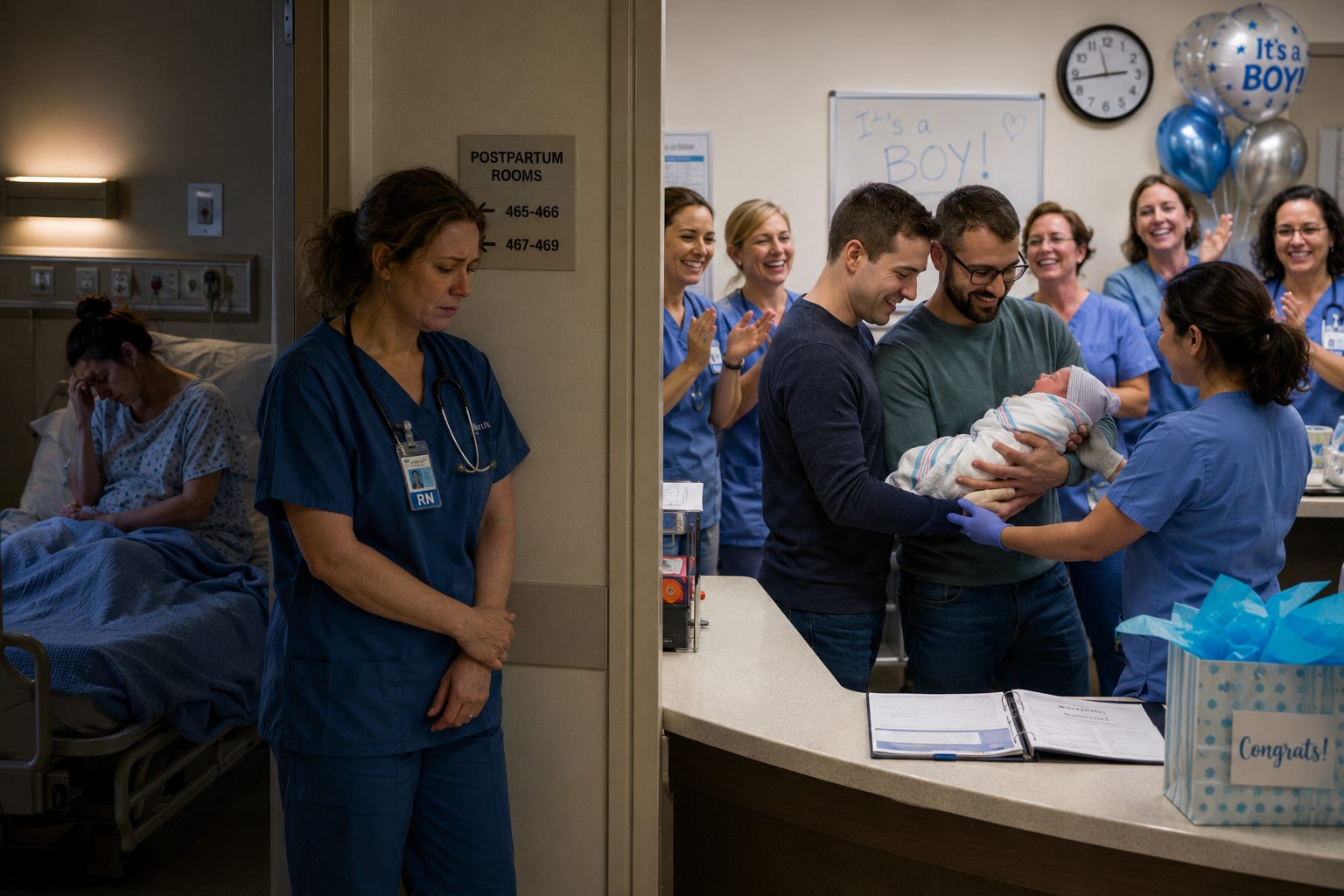
“The mother wants to see the baby,” the nurse said. Her face was distraught as she pulled me aside, whispering, “…and she is not okay.” The birth had been especially challenging, leaving the mom in more pain than usual. But that pain was outweighed by something deeper. We all knew why. We had been through enough deliveries to know exactly what a woman needs after she gives birth.
Her arms were empty. And it hurt.
She instinctively wanted to see her baby, but she had surrendered her rights to do so. She was under contract. And she had been paid for it. It was her egg, her child, her biological son, but her parental rights had been traded for cash.
“Oh, how beautiful!”
“Wow, this is so amazing.”
“Those two dads must be so happy,” exclaimed nurses, doctors, and managers from the nurses’ station, praising the situation as though it were a pinnacle moment for our culture (and they had better be on the “right” side of it).
But when the little boy entered the world, instead of being placed on the warm, familiar-smelling, and familiar-sounding chest of his mother, he was whisked away to the chest of a stranger…to a life where he would have no mother.
And everyone applauded.
Story #2
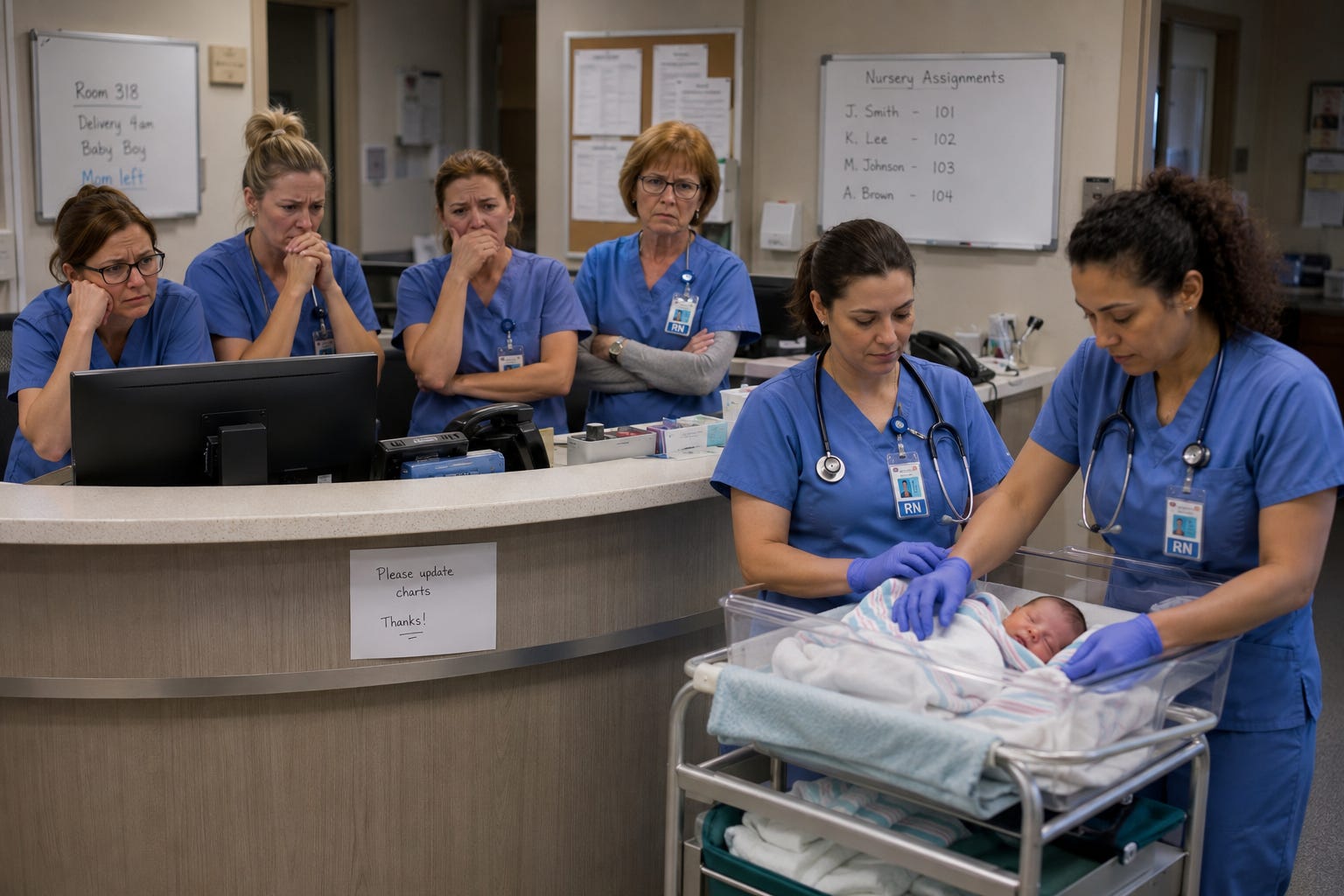
“Did you hear? She’s gone. Left a note and disappeared sometime in the night. Just left the baby here.”
“How awful.”
The anger towards the birth mom from the nurses’ station was palpable. How could she leave her baby? Why would anyone do that? It is completely unacceptable.
“That baby girl is so beautiful, so perfect!”
Instead of being loved and held in the warm, familiar embrace of her mother, she was held by strangers, nurses. She had no biological mother to soothe her.
She had surrendered her rights to that baby when she walked out. It was her egg, her child, her biological daughter. But she had left her for reasons unknown.
We rage on behalf of those babies. We mourn for them. We create systems to protect them. We defend them and rightly cry, “Babies need a mother!”
No one applauds.
I’ve worked labor and delivery long enough to have watched our culture change in real time. Early in my career, the story that kept me up at night was the mother who disappeared. Now, years later, what I cannot shake is the mother who had every biological instinct to stay and was paid to leave anyway. Few of my colleagues could recognize the double standard between them. Fewer still could articulate it.
A mom who leaves her newborn and vanishes is abhorrent. The baby will be consoled: “Your mom shouldn’t have left you. She probably loved you so much, and we don’t know why she did what she did.”
A mom who is paid to leave her newborn in the room across the hall is a hero. The baby will be told, “You should be happy you have two dads.”
Both babies deserved better. They deserved their biological mother and father and their committed presence throughout childhood, because children have a natural, fundamental right to the people who created them. But instead, they both experienced the same profound loss: their biological mother. Their birthday gift was the grief they would spend their childhood and adolescence trying to understand.
We are to believe that mothers are both irreplaceable and interchangeable. Desperately needed and not significant. Important and inconsequential. Biologically tied to their children and able to sever that tie for cash, depending on the scenario.
Celebrate Orphans in Room #1, Lament in Room #2
We just celebrated Mother’s Day. We filled social media with tributes, called our mothers, bought flowers, and said what we say every year: that a mother’s love is unlike anything else on earth, that no one can take her place, that the bond between a mother and child is sacred and irreplaceable.
We meant every word. We just don’t act like it.
This nurse has watched babies over her career and the double standards applied to their origins. One mother walked out and was condemned for it. The other was paid to leave and was celebrated for it. The babies were not consulted. Each baby went home carrying identical losses, and we told one of them to be grateful.
The science is not ambiguous on what that loss costs. A birth mother’s scent actively reduces her newborn’s stress hormones. Her skin regulates the baby’s vital functions. Her milk protects the developing brain. Researchers won’t study extended maternal deprivation in human infants because separating babies from their mothers would be considered cruel and unethical. Federal law won’t let you take a puppy from its mother before eight weeks. We extend that protection to animals precisely because we know what early separation does to a developing creature. We know. And then we write it into contracts, dress it up as generosity, and applaud it in our delivery rooms.
Surrogacy does not give a child a family. It begins a child’s life by guaranteeing the loss of the one person their biology was organized around before they drew their first breath. No adult’s longing, however genuine, is a right that a child is obligated to satisfy. Children are not commodities. They are not the solution to adult desire. Every child has a right to their mother, and every time we subordinate that right to what adults want, the child pays a price we’ve decided in advance they should simply accept.
Do we actually believe mothers are irreplaceable? Because if we do, we cannot keep building a world where motherhood is the most sacred thing we celebrate in May and the most easily purchased thing we sell in June.
It’s time to put them before us. If you haven’t joined our team supporting our work, consider starting your monthly gift or making a one-time gift today.
Want some more resources about surrogacy? Check out our articles here:


Them Before Us is a global movement committed to defending children’s right to their mother and father. We believe that adult desires should never come at the expense of a child’s fundamental needs.
We are not professional lobbyists or political insiders. We are ordinary people with an extraordinary conviction: children must come first in every conversation about marriage, family, and fertility. We exist to make one thing clear: when adults sacrifice for children, society thrives. When children are forced to sacrifice for adults, everyone pays the price.
Find us around the web: Facebook, X, YouTube, Instagram, Podcast, TikTok & Radio.
Thank you for this – and highlighting the double standard so heartbreakingly. There is another double standard, too, which we like to overlook – every effort being made to save the life of a pre-term baby, while just along the corridor, the life of child of the same age is deliberately ended, through abortion. When a child is a commodity to be bought, and which a mother is prepared to sell, or a baby's value and right to life depends on being wanted, we live in very dangerous times.
Surrogacy is disgusting and evil. It is an abomination and goes contrary to every law of nature; it should be made illegal and those who engage in it punished harshly.