

Does My Disability Justify Using a Donor?


Imagine you were born with a significant physical disability that made it impossible to have children on your own. You meet the person you love, and together you feel that very natural longing for a child. Now imagine that the only way to make that happen is by bringing in a third party, paying for sperm, eggs, or another person’s body to create the child you cannot conceive together. The question isn’t how strong your desire is. It’s whether it’s right to intentionally create a child who is separated from one or both of their biological parents from the very beginning, to fulfill that desire. If anyone has justification for using third-party reproduction, it’s folks who have a disability preventing natural conception, right?
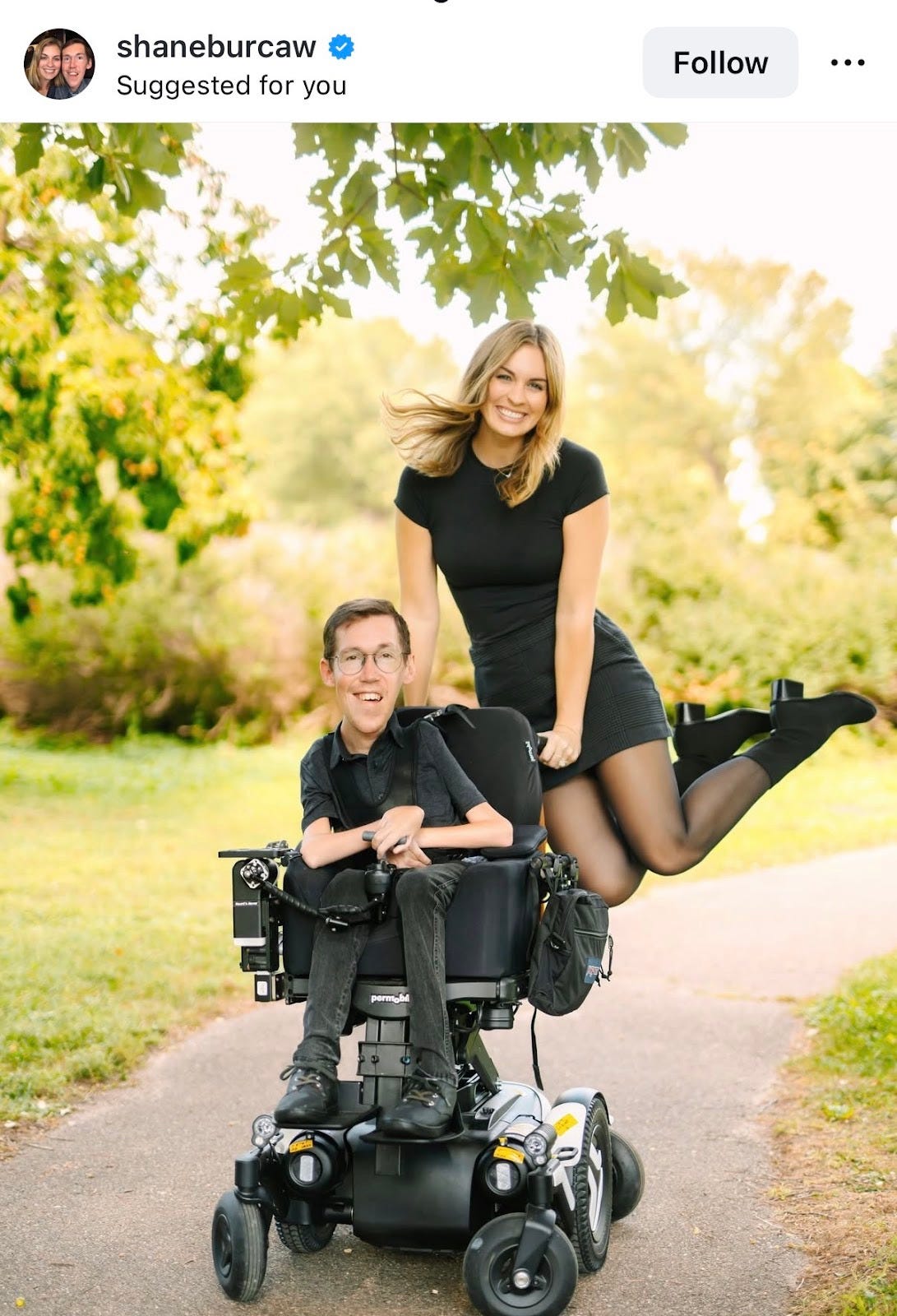
For those who don’t know Shane and Hannah Burcaw, they are known as “Squirmy and Grubs” on YouTube and share their lives with the internet as an interabled couple. Shane, also known as “Squirmy”, has Spinal Muscular Atrophy. He and his wife, Hannah, “Grubs”, are advocates against ableism and show the world that disabled men and women can have just as fulfilling and meaningful lives as anyone else. They’ve been sharing their journey as a married couple who hope to grow their family, but have struggled with infertility. Recently, they opened up on Instagram about how they are considering using donor conception on their reproductive journey.
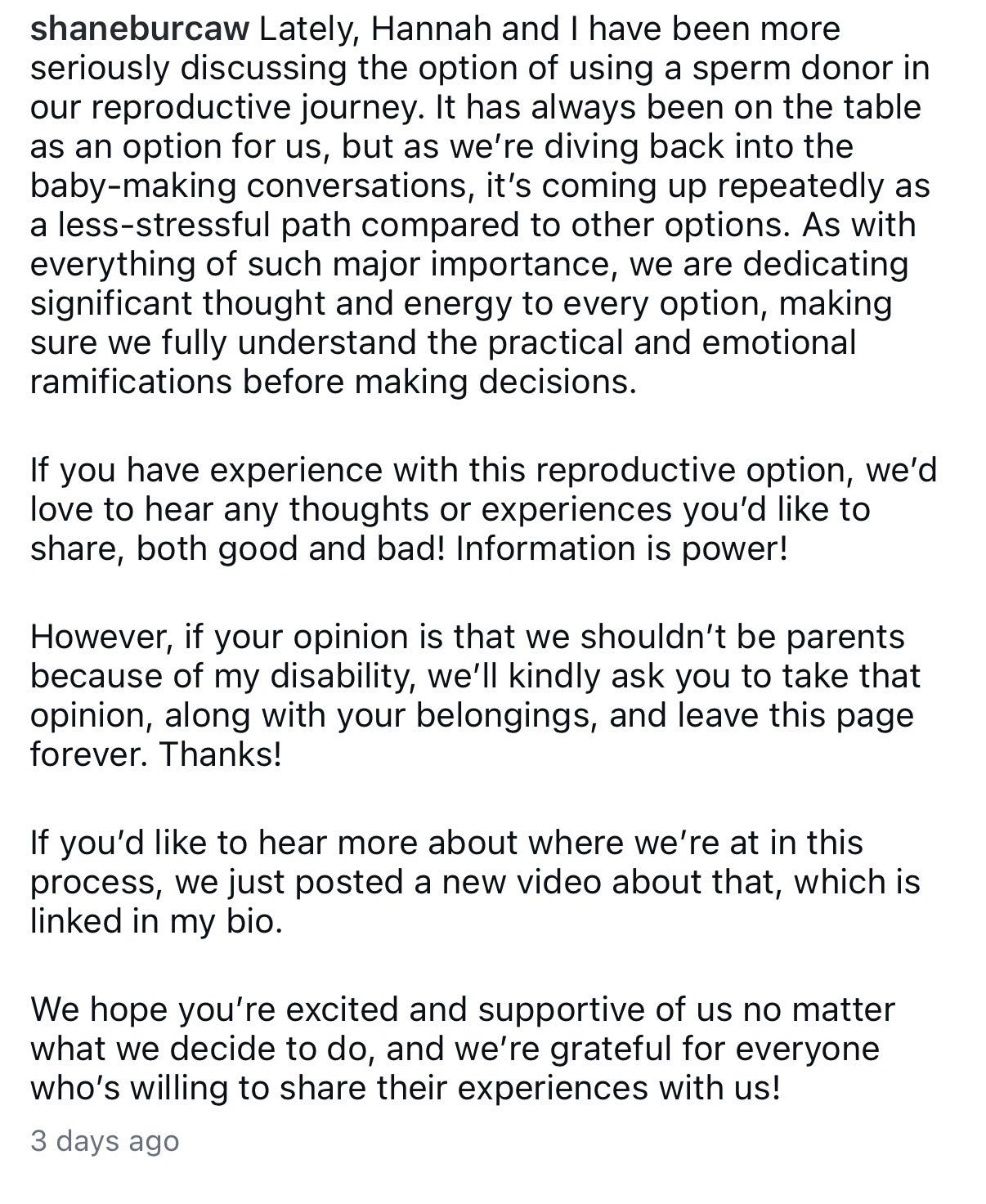
In this case, donor conception would mean using sperm from a donor and combining it with Hannah’s egg to create a child. The embryo would then be implanted into Hannah’s womb to grow and, hopefully, result in the baby they long to bring home. They aren’t taking this decision lightly and sincerely asked their friends and followers for their thoughts and perspectives. So, as a personal fan, I (Sam) wanted to respond with love and facts about donor conception.
Here is my open letter to Squirmy and Grubs, but also to any other couple struggling with infertility and considering donor conception.
A Gentle Warning
Hi, I know we don’t personally know each other, so naturally, I understand the urge to ignore my opinion on something as personal as your reproductive journey. But in this case, you asked, and I felt moved to respond. First, I want to say that I am a longtime fan of your work and genuinely wish you both only good things. Genuinely. Because of that, I want you to get the full picture of donor conception and to seriously consider another path to parenthood. And to be clear, I agree with you that your disability should not prevent you from becoming a parent.
I am also an advocate against ableism, and one thing most people aren’t aware of is the eugenics embedded in the IVF and donor conception industry. If you are going to pursue a sperm donor, most cases for that require using IVF. I believe it’s important to understand the issues with the industry before taking that path. Big Fertility is a marketplace. Buyers pay more for gamete sellers with “desirable traits” such as attractiveness, athleticism, academic achievement, and white skin. If an embryo tests positive for a genetic anomaly, clinics often see only one future for that child: the trash bin. Clinics don’t want their success rates to look worse by producing a disabled “product”. Any embryos that tested for any sort of disability would be culled from existence. The industry views these little human beings as commodities. People seeking these services are encouraged to choose clinics with the highest success rates, meaning not only high birth rates but high rates of babies deemed “healthy” and “fit.”
As you advocate for men and women with disabilities, we advocate for children.
Donor conception violates children’s right to life, right to their mother and father, and right to be born free, not bought and sold.
IVF is NOT Child Friendly
Most donor children (DC) are conceived in glass (IVF). Many babies won’t survive the thaw or transfer from being frozen, and the few that do implant may be “selectively reduced” (aborted), or have their siblings “selected” for disposal. Many will spend decades in a freezer, if they ever make it to birth at all. There are many other concerns we, as a child rights organization, have with IVF. But beyond the issue of eugenics, I also wanted to give you something to consider that you may not have yet, especially since you may not even be planning to use IVF as part of your donor conception journey.
When you use a “donor,” that’s not just sperm. Once a child is created using that sperm, the person it came from is not simply a donor. He is a father. Your child’s father. And purposefully creating a baby while knowing that the father does not want them, and that they will likely never have the chance to know their biological dad, is wrong. It is a cruel thing to do to a child, and it greatly affects them.
Children not only need their mother and father, but also have a right to both.
“We are their mother and father.” That is only half true. Hannah would be that baby’s mother in every way. She would be their biological mother, their gestational or birth mother, and their social mother. But you would only be their social father. That is not nothing. It is beautiful to care for a child. There is no doubt that you would make a wonderful father. But children do not just need love. They need their mother and father, the two halves of their identity.
Any time a loss occurs, there is trauma. We recognize this in every other situation. When a baby loses their biological father in any other way (death, abandonment, neglect, abuse, etc), we all recognize the tragedy in those situations. Even in cases where a child loses their dad before they ever get the chance to meet him, we still understand that something very important was lost. The man they come from will not be there to raise them, care for them, or connect them to the history of his side of their life.
Why is it any different with donor conception? Because we are doing it on purpose? Doesn’t that make it worse?
The desire for a child is good. It is natural, and we understand it. But that desire should never come before the needs and rights of the child.
One of the comments on your Instagram mentioned listening to donor conceived people to hear their experiences. We wanted to share some of their stories here:
Mum told me when I was a child. All about how desperate she was for a baby, and how much I was wanted, and I was special. It doesn’t feel like that. I’m middle-aged now, and I went through a phase of kidding myself it doesn’t matter. But it does. It always has if I’m honest.
‘I don’t know how to express with words how distressing it is to have half of your identity ripped away in a moment like that.... There isn’t a handbook on how to rebuild your sense of self when you discover that your non-identifiable father sold you.’- Ellie
“I cannot describe what it feels like to see your father’s face for the first time…. The lopsided, half-empty feeling I had every day of my life, suddenly filled. I was a whole and complete person for the first time in my life.” - Anonymous DC person
These are not the minority. These are common experiences among donor-conceived children. DC kids overwhelmingly believe knowing their biological parentage is essential for good mental health. Many describe feeling fraudulent, untethered, and alone. Even when raised in a two-parent family, they long for their biological parent.
64% of DC adults say their sperm donor represents half of who they are.
70% believe they have been harmed by an anonymous donation.
89% percent believe it is important to know the identity of their donor.
The wants of commissioning parents pale in comparison to the needs these children have to understand who is responsible for their attributes.
Here’s an interview with Kathryn Francisco, who didn’t know her dad wasn’t her biological father until her 20’s.
The Unknown Half Siblings
Another reality that is often overlooked is that donors are frequently used many times. That means your child could have half-siblings they do not know about, and as DNA and genetics services are on the rise, it’s not if they’ll find them, but when. Many DC adults become consumed with finding their missing half-siblings. Some worry about accidentally being related to a romantic partner. Others spend years searching for their biological parents. According to We Are Donor Conceived, seventy percent of donor children who take DNA tests discover at least one donor sibling. Seventy-nine percent find one to ten siblings, while five percent discover far more.
“I was also shocked to find out what a huge number of donor-conceived half-siblings I probably have living near me. At least twenty, maybe over fifty. It is painful to know that I likely won’t ever even know most of their names, let alone get to meet them. They are unlikely to have been told they were donor-conceived. I love them and miss them without even knowing them.” - Ellie
The hard truth is that donor conception shifts the emotional burden of an adult longing to become a parent onto a child who will long for their missing parent for a lifetime. We urge you to reconsider this option.

Alternative Journeys to Parenthood
I am not saying that you should not become parents. But I hope you pursue parenthood in a way that does not conflict with a child’s rights or cause harm to them. You may have already explored this, but I encourage you to look into restorative reproductive medicine. The goal is to identify the root cause of infertility and treat it if possible. If a biological pregnancy is not possible, I hope you would consider adoption or foster care.
Once again, I want to make it clear that I wish the best for you both and pray that you find a way to become parents. The world needs more parents like you.
Thank you for taking the time to read this.
Sincerely, Samantha DeLoach and the Them Before Us team
Them Before Us is a global movement committed to defending children’s right to their mother and father. We believe that adult desires should never come at the expense of a child’s fundamental needs.
We are not professional lobbyists or political insiders. We are ordinary people with an extraordinary conviction: children must come first in every conversation about marriage, family, and fertility. We exist to make one thing clear: when adults sacrifice for children, society thrives. When children are forced to sacrifice for adults, everyone pays the price.
Find us around the web: Facebook, X, YouTube, Instagram, Podcast, TikTok & Radio.
 | A guest post by
|
“We are their mother and father.” That is only half true. Hannah would be that baby’s mother in every way. She would be their biological mother, their gestational or birth mother, and their social mother. But you would only be their social father. That is nothing. It is beautiful to care for a child. There is no doubt that you would make a wonderful father. But children do not just need love. They need their mother and father, the two halves of their identity.
"That is nothing." I'm pretty sure you meant to say that is NOT nothing here...
Excellent article! Praying that they make the right decision.