

Frozen alive.
The dangerous IVF procedure no one talks about


Imagine a young couple, let’s call them Jake and Emily, sitting across from a doctor in a sterile office. They’ve been trying to have a second child for three years. The tests, the treatments, the monthly disappointments. They’ve been through all of it. They have a two-year-old son named Liam. He’s healthy, happy, and the center of their world. But a second pregnancy has not come.

The doctor leans forward. “I have good news. We’ve developed a new procedure, truly revolutionary, that can help you conceive. But there’s a catch. We need a small piece of tissue from Liam’s heart. The only way to retrieve it is through open-heart surgery.”
Jake and Emily look at each other.
“Now, before you worry,” the doctor continues, “this is a very safe procedure. The mortality risk is low, somewhere between two and five percent. Ninety-five times out of a hundred, Liam will come through just fine.”
Let that settle for a moment.
Two to five percent. That’s the number. The doctor is calm. The science is sound. The procedure is routine. And the vast majority of children who undergo it survive without complication.
Jake stares at the floor. Emily’s hand tightens around Liam’s sippy cup. They want another child, deeply, agonizingly. Three years of loss have taken a toll on their marriage, their hope, their sense of what their family was supposed to look like. This doctor is offering them a way forward. And the odds are overwhelmingly in Liam’s favor.
But.
Two to five percent. Two to five out of every one hundred children. They look at Liam, babbling in Emily’s lap, pulling at the stethoscope on the counter, oblivious to the conversation that will determine whether he is wheeled into an operating room so his parents can have another baby. Not to save his life. Not to treat his disease. But to serve someone else’s purpose entirely.
In medicine, we tolerate a two-to-five-percent chance of death for one reason only: when it is the only way to save the life of a child.
A child born with a heart defect who will die without surgery, yes, we accept those odds, because the alternative is worse.
No doctor on earth would operate on a healthy child, at any level of risk, for a purpose that has nothing to do with that child’s own wellbeing. That is not medicine. That is something else entirely.
Jake and Emily would say no. You would say no. Every parent you know would say no.
And yet this exact risk, this exact statistical gamble with children’s lives, is accepted in fertility clinics hundreds of thousands of times a year.
The Risk No One Talks About
Here is something most couples are never told before they begin IVF: virtually every embryo created in the process will be frozen.
Not because something went wrong. Not as a backup plan. Because that is how the system is designed. In 2023, 432,641 IVF cycles were performed in the United States. More than 40 percent were freeze-all cycles in which every embryo created was frozen and no transfer happened at all. Of the transfers that did take place, 86.9 percent used previously frozen embryos. Only 15,928 fresh embryo transfers occurred all year, down from nearly 63,000 just five years earlier. And because single embryo transfer is now standard, used in more than 82 percent of all transfers, even the cycles that do transfer a fresh embryo almost always freeze the rest.
Too complicated? The math boils down to this: virtually every embryo created through IVF will be frozen.
Many couples who consider themselves pro-life go through this step believing they’ve drawn the ethical lines that matter. They won’t screen for disease. They won’t select for sex. They won’t discard embryos or donate them to research. They believe they are doing IVF the right way, avoiding the parts that conflict with their values. What they do not realize is that the step most consider routine, the freezing itself, is not routine at all.
It is the single most dangerous part of the unnecessary process that will happen to their child. And almost no one tells them.
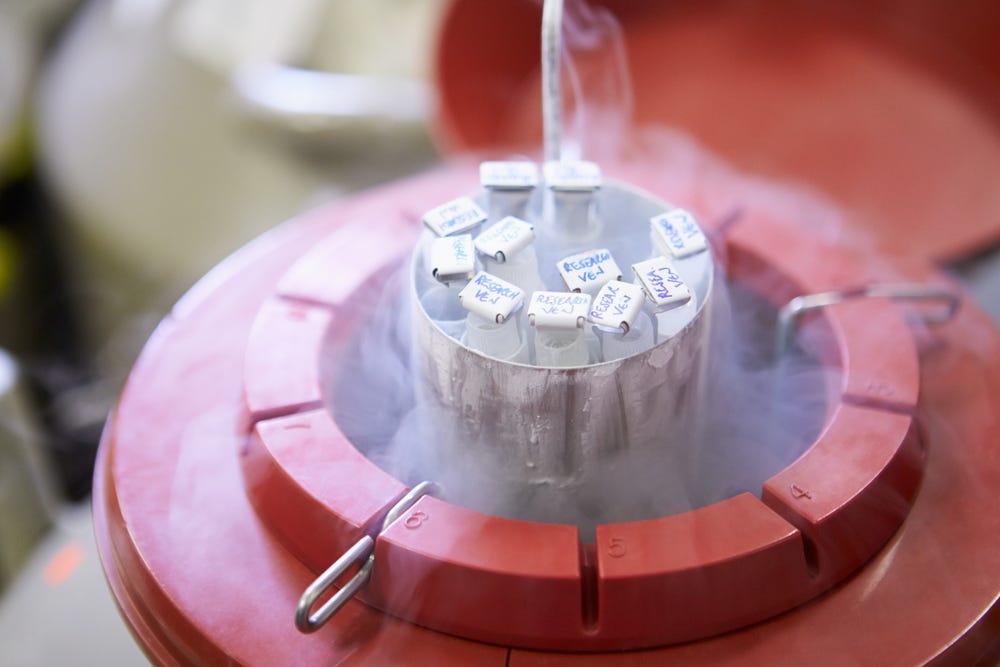
The survival rate upon thawing is, depending on the clinic, somewhere between 95 and 98 percent. That means one to five percent of embryos, living, genetically distinct human organisms, do not survive. (Important to note, that some studies have put the percentage of loss much higher, 95-98% is the best case scenario)
And to be clear about what is being frozen: these are not eggs. An unfertilized egg is a woman’s own cell, tissue, stored for future use. An embryo is something fundamentally different. Fertilization has already occurred. A new, genetically distinct human, with a DNA sequence that has never existed before and will never exist again, has already begun to develop. What is being frozen is not potential life. It is a human being on day three or five or seven of his or her life.
But here, the risk is routinely accepted. Influencers post casualty updates about how many of their embryos “didn’t survive the thaw” as though they had nothing to do with it, as though this is just a sad but unavoidable fact of life, like weather. It’s not. This was a medical procedure. It was performed on a child they created. And it was not medically necessary. Not for the embryo. Not in any way, shape, or form. No doctor would ever tell you that freezing is required to save an embryo’s life. It is required to make the business work.
And the risk is not being borne by one child to save that child’s life. It is being imposed on many. A single IVF cycle might produce ten or more embryos, each one frozen, each one subjected to that same chance of death independently. Many families are not asking one child to endure this process. They are asking multiple children to endure it.
“But Embryos Are Lost in Natural Pregnancy Too”
This is the most common response, and it deserves a direct answer.
Yes, pregnancy is already difficult. Heartbreaking, even. An estimated 30-50% of naturally conceived embryos do not survive to birth, lost to failed implantation, chromosomal abnormalities, or early miscarriage. Every parent who has suffered a miscarriage knows this grief intimately.
But freezing has absolutely nothing to do with that.
The natural risks an embryo faces on the way to birth, implantation failure, developmental arrest, miscarriage, are inherent to the biology of human reproduction. They exist whether or not IVF is involved. Freezing is not one of those risks. It is a specific, additional, unnecessary risk imposed on a developing human being by a medical procedure that serves the convenience of the process, not the welfare of the child. It is an entirely different category.
If a child is lost to miscarriage, that is a tragedy no one chose. If a child is lost to a failed thaw, that is a tragedy someone authorized, and one that was completely avoidable.
Why Freezing Is the Linchpin
You may be wondering: if the risk is real, why can’t couples just skip the freezing?
Because, truthfully while a very small number do, modern IVF doesn’t work without it. Freezing isn’t a feature of the process. It is the process.
In a standard IVF cycle, a woman’s ovaries are stimulated to produce far more eggs than nature would, sometimes a dozen or more. Those eggs are fertilized, and the resulting embryos are allowed to grow for several days. Then they are graded, ranked, and in many cases biopsied for genetic testing to screen for chromosomal abnormalities. The results take one to two weeks. The embryos must be frozen while the lab decides which ones make the cut.
This is where the process becomes something other than medicine.
The embryos are screened for abnormalities. They are scored, often by AI-driven grading systems, and sorted into categories of desirable and undesirable, high quality and low quality, likely to succeed and unlikely to succeed. The embryos that receive the highest grades are transferred first. The rest are set aside, sometimes indefinitely. Some are labeled “unviable” and parents who don’t know to push back accept that word at face value. But ask the question the doctor hopes you won’t: “is it a zero percent chance this embryo will survive, or just a low one?” The answer is unsettling. There is no grade, no score, no algorithm that can tell you with certainty that a given embryo will not make it. Every single grade on the scale, including the lowest, has resulted in live births. Babies have been born from embryos that the system said should be discarded.
The only environment in the world where an embryo has the highest chance of becoming who they were meant to be is not a lab, not a freezer, not a petri dish scored by software. It is a mother’s womb.
Understanding why clinics grade embryos at all requires understanding what “success” means to the fertility industry. A clinic’s success rate is its marketing. It is the number that attracts patients, justifies the price tag, and sustains the business. That number measures one thing: how often a transfer results in a baby taken home. Clinics know that most couples will only attempt a few transfers before stopping, whether because of cost, exhaustion, or heartbreak. So the math is simple. If you only get a few shots, you need to make each one count. And the way you make each one count is by choosing only the embryos most likely to succeed. That means you need a large batch to select from. That means you need to stimulate, harvest, fertilize, freeze, test, grade, and pick the winners. The success rate the clinic advertises is not a measure of how well IVF works. It is a measure of how well selection works. It is a statistics game built on excess and grading, and the cost is paid in embryonic life.
Without freezing, you can’t test every embryo. Without testing, you can’t select the “best” one. Without selecting only the “best”, the success rates that clinics market collapse. Clinics know this. It is not a conspiracy. It is a business model.
But without the ability to mass-produce embryos, screen them, freeze them, and select only the winners, IVF’s per-cycle success rate drops into a range that is barely distinguishable from natural conception for many couples. That is what the technology delivers once you strip away the parts that cost embryonic lives. The headline success rates are not a testament to medical innovation. They are a testament to volume and selection.
This is precisely why restorative reproductive medicine exists. Approaches like NaProTechnology and other fertility care models seek to identify and treat the actual cause, endometriosis, hormonal imbalances, ovulatory dysfunction, structural issues, so that conception can happen naturally, without creating and risking embryos in the process. It is the difference between healing a patient and managing a production line.
What Two to Five Percent Actually Looks Like
The two-to-five-percent range sounds small. It is meant to sound small.
But we didn’t pull those numbers out of thin air for Jake and Emily. The risk the doctor described, a two-to-five-percent chance that Liam would not survive the procedure, is the actual mortality rate for open-heart surgery on babies.
The Society of Thoracic Surgeons’ national database, covering nearly 145,000 pediatric cardiac operations, reports aggregate operative mortality at 3.0%. The arterial switch operation, one of the most common open-heart surgeries performed on newborns, carries 1.4 to 3.8% mortality.
These numbers come from the largest surgical registries in the world. And they are nearly the exact same range that describes embryo loss during the freeze-thaw process.
Today’s best freezing method is called vitrification, a flash-freezing technique that turns an embryo to glass in seconds. It is, by all accounts, a marvel of modern science. And it kills two to five percent of the embryos subjected to it.
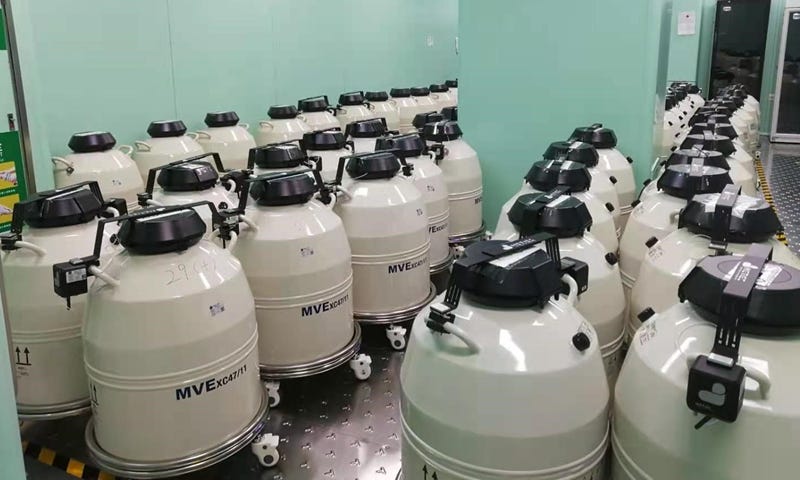
An estimated seven to twelve million human embryos sit in frozen storage worldwide. Apply the midpoint loss rate of three percent to those embryos, and somewhere between 200,000 and 360,000 of them will not survive the thaw. That is a body count.
But here is the part almost no one knows. Vitrification only became the standard around 2013. Before that, embryos were frozen using an older, slower method. And the results were not just worse. They were catastrophic. In a landmark clinical trial, researchers found that 47.5 percent of slow-frozen embryos did not survive. Nearly one in twenty patients had every single frozen embryo die, a total wipeout, with nothing left to transfer. Every embryo frozen before approximately 2005, and many frozen in the years after, was subjected to those odds.
So when the industry says that freezing technology has “improved,” understand what improved means. It has improved to the point where the risk of death is now equivalent to open-heart surgery on a newborn. That is the floor. That is the best-case scenario after forty years of development and billions of dollars in research. The kind of risk that would stop any parent cold. The kind of risk that would make you cancel every plan you had and sit in a hospital waiting room praying. That is what the fertility industry now markets as routine. As safe. As just part of the process.
The Disconnect
So why doesn’t this trouble us?
Why would Jake and Emily, and every parent reading this, recoil at the thought of a 2–5% risk to Liam but accept the identical odds for their embryos without a second thought?
The answer is painfully simple: location.
Liam is in their arms. He has a name. He has a face. He laughs when you blow raspberries on his belly. He reaches for them when he’s scared. The embryo is in a lab, in a freezer, behind a door they’ll never open, in a room they’ll likely never see.
But the risk is the same. The math doesn’t change because the patient is smaller. The chance of not surviving a procedure doesn’t become acceptable just because the one at risk can’t cry out.
We would never subject a healthy toddler to a procedure with that mortality rate, a procedure that has nothing to do with saving that child’s life. We call that unconscionable. But we routinely freeze embryos, sometimes a dozen at a time, knowing that not all of them will make it, and we call that family planning.
What This Is
This isn’t an argument against couples who long to have children. That longing is deep and good and human.
This is an invitation to ask a question that the fertility industry has very little incentive to raise:
If we wouldn’t accept this risk for the children we can see, why do we accept it for the ones we can’t?
Maybe the answer is that we’ve been subtly trained to think of embryos as something other than what they are, as potential rather than persons, as biological material rather than beginnings. The language helps. We say “cryopreservation” instead of “subjecting a human to a process with a 5% fatality rate.” We say “failed thaw” when what we mean is that someone didn’t survive.
But if you believe, as we do, that the life of a human being begins at fertilization, that what is frozen on day five is not a cluster of cells but a boy or a girl at the very beginning of their life, then the freezer isn’t storage. It’s a gamble. And every thaw is a moment where someone either survives or doesn’t.
No parent would consent to the surgery.
The question is why we consent to the freeze.
Them Before Us is a global movement committed to defending children’s right to their mother and father. We believe that adult desires should never come at the expense of a child’s fundamental needs.
We are not professional lobbyists or political insiders. We are ordinary people with an extraordinary conviction: children must come first in every conversation about marriage, family, and fertility. We exist to make one thing clear: when adults sacrifice for children, society thrives. When children are forced to sacrifice for adults, everyone pays the price.
Find us around the web: Facebook, X, YouTube, Instagram, Podcast, TikTok & Radio.
About the Author:
Josh Wood serves as the Executive Director of Them Before Us, advocating globally for the rights and well-being of children.
He lives in Charlotte, North Carolina with our 4 kids.

This was painful to read but so comprehensive & informing on this procedure & it's true cost in lives. Being firmly, unmovably prolife, I find myself wondering how this dreadful truth about IVF & freezing wasn't already residing somewhere in my conscience.
Holy crap!