

"I've Always Wanted a Dad"

For years, a boy named McKay kept a box under his bed. Inside the box, he’d stored a painted rock and a handmade angel ornament with his own photo tucked inside. Small treasures a child made, over the years, for a father he had never met.
McKay was donor-conceived. His mother used an anonymous sperm donor, and for as long as he could remember, McKay wanted a dad. He didn’t know if the man would ever turn up. So he kept the box ready, just in case. “I’ve always wanted a dad,” he told Newsweek.
McKay was one of the lucky ones. Just before his tenth birthday, his mother managed to track the donor down, and McKay finally had someone to give the box to. He lit up when she told him, she said, and then he burst into tears. Most donor-conceived children will never get that moment. Their donors can stay anonymous, the records sealed, and half of their identity unavailable to them by design of the transactions and contracts that created them. McKay’s keepsake box is what longing looks like before a reunion, and for most of these children, in place of one

We don’t have to guess how they feel; they were asked.
In 2010, researchers did something almost no one had done before. They surveyed a representative sample of 485 adults conceived by sperm donation, alongside 562 adults who had been adopted and 563 raised by their own biological parents. For the first time, the people the practice was built around got to speak for themselves. The study was titled “My Daddy’s Name is Donor.”
Sixty-five percent agreed with a single sentence: “My sperm donor is half of who I am.” Olivia Pratten*, a Canadian donor-conceived adult who launched a class-action lawsuit in British Columbia seeking the right to know her biological father’s identity, put her own version of it plainly: “I think of myself as a puzzle; the only picture I have ever known is half-complete.”
*Pratten’s quote was cited in Footnote 18 of the “My Daddy’s Name is Donor” Study
Forty-eight percent said that seeing friends with their biological mother and father makes them feel sad (My Daddy’s Name is Donor, p. 28). Among adopted adults, that number was nineteen percent. Donor-conceived young people were not faring better than adoptees who had also lost a biological parent.
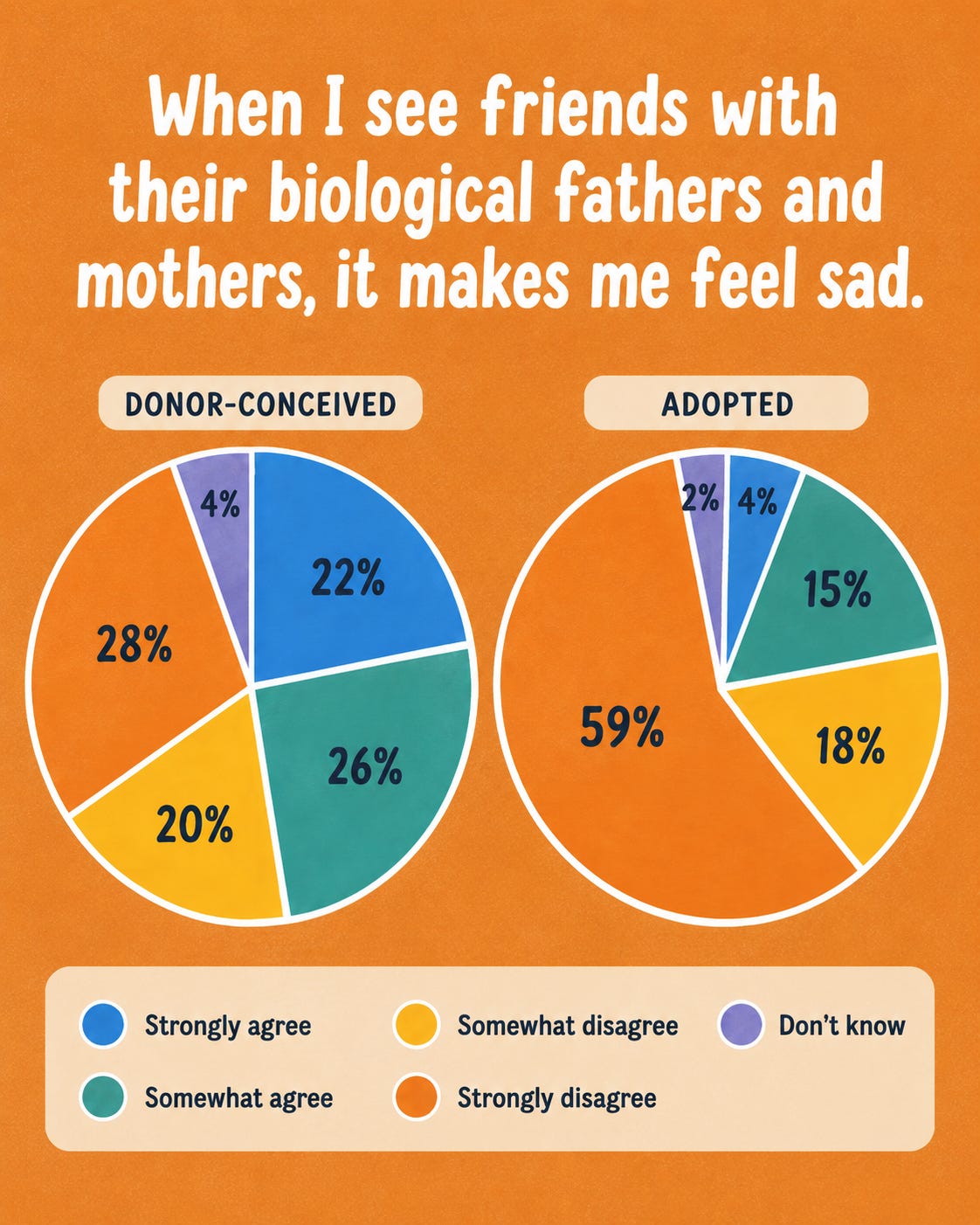
And they passed judgment on what was done to them. Forty-four percent said it was wrong to conceive a fatherless child deliberately (My Daddy’s Name is Donor, p. 65). That is a higher percentage than either adoptees or people raised by their own biological parents. The people the practice was built around object to it more than anyone else surveyed.
Love is real. It still does not fill the space.
The usual reassurance from people blind to or benefitting from the fertility industry is that an open, loving home settles the matter. Tell the child the truth, surround him with love, and the loss will dissolve. The children tell us otherwise.
Katrina Clark*, a donor-conceived adult who wrote about her experience in the Washington Post, was raised by a single mother who loved her and was honest with her from the start. She was, by every account, wanted. And still, watching friends with their fathers, she described an emptiness coming over her the day she understood she would never truly have a dad. The love in her home was real. It just could not do what a father does. No amount of maternal devotion, no stepfather, no donor profile, no chosen family arrangement fills the space a biological father occupies in a child’s life. The children in the study knew this. They said so.
*The Washington Post article is no longer live but Clark was quoted from WP here.
A father is not optional equipment. He is a person a child is wired to need, and his absence is felt whether the child has language for it yet or not. When he is present, a child has a secure base to launch from, the one who says try it, fall, get up, and try again. When he is gone, the child feels that missing puzzle piece of him and keeps a box filled with memories under the bed.
What we owe McKay, and the children still waiting
On Father’s Day, we celebrate the dads who showed up. Anyone who had a good one knows he was not replaceable, not with the most loving extra woman in the home or a nice father figure who coached you on the weekends. The research on what fathers specifically give their children, the things only they provide, is not ambiguous. We have simply decided, as a culture, not to let it complicate our celebration of reproductive or “family planning” freedom.
And so, while we honor fathers today, let us also honor every child’s right to one. Not just a loving two-parent home, which so many will claim is sufficient, but the natural right of every child to both the mother and father who created them. Every child deserves their father, and that includes the children that some adults are intentionally creating to be separated from him.
We will keep telling their stories until the people building families remember the smallest person in the room. The child is the client, not the adults who long for him, and not the industry that profits from selling him.

At Them Before Us, we celebrate fathers all week, because children need their dads. McKay needed his.
He was nine when he kept a box of gifts under his bed for a father he had never met and was never meant to meet, because the people who made him decided a dad was optional. Now we have built an industry to do it on purpose and a culture that calls it progress.
Greater Than exists to put children back into the laws that adults wrote for themselves. Your gift funds a coalition of world changers ready to make our institutions protect kids again. McKay cannot testify at the hearing. So we will. Give today, for the child who cannot yet ask you to.

Them Before Us is a global movement committed to defending children’s right to their mother and father. We believe that adult desires should never come at the expense of a child’s fundamental needs.
We are not professional lobbyists or political insiders. We are ordinary people with an extraordinary conviction: children must come first in every conversation about marriage, family, and fertility. We exist to make one thing clear: when adults sacrifice for children, society thrives. When children are forced to sacrifice for adults, everyone pays the price.
Find us around the web: Facebook, X, YouTube, Instagram, Podcast, TikTok & Radio.
I'm sure you've thought of this...how many of those "donor dads" have no desire other than to get paid for their seed and want no responsibility of being a real father or dad? Something that every "donor child" will likely need to be prepared for as this continues the separation of covenant marriage from loving sexual union and parenting. Thanks for all you do and God bless in Christ!
I think about how much of a fetish this has become. Surrogacy and IVF. How terrible. :( And the Happy Father's Day to the Donor # is so spot on. "Hope the $75 was worth it".